Metrology-stable smart meter PCB assembly: bulk metal foil shunts, matched thin-film arrays, aging-compensated algorithms. Achieve <0.1% drift over 25 years. Explore revenue-grade high-reliability assembly. IEC 62053-22 Class 0.2S certified. OTOMO.
Precision Unwavering: Engineering Metrology Stability into Smart Meter PCBs Where Component Aging Meets Decades of Measurement Integrity
Global forensic analysis of 9.1 million deployed meters reveals 24% of regulatory non-compliance incidents originate from metrology drift: shunt resistor aging inducing 0.41% error after 10 years, capacitor dielectric absorption distorting waveform sampling, temperature coefficient mismatches in voltage dividers, and EEPROM corruption of calibration constants during thermal cycling (IEEE Transactions on Instrumentation and Measurement, 2026). A single 0.5% drift beyond ±0.3% regulatory limits triggers mandatory recalibration costing €87 per meter—translating to €43.5M for a 500,000-meter deployment. At OTOMO, metrology stability isn’t calibrated periodically—it’s engineered into component physics, circuit topology, aging-compensated algorithms, and field-validated drift models. Our high-reliability PCB assembly embeds multi-decade stability protocols, accelerated aging validation, and self-diagnostic calibration intelligence directly into the board’s metrological DNA—transforming vulnerable measurement chains into unwavering guardians of energy commerce across 25+ years of silent, precise operation.
📏 The Metrology Mirage: When "Initial Calibration Accuracy" Meets Decades of Component Aging
Critical metrology drift mechanisms:
⚠️ Shunt Resistor Aging: Metal alloy crystallization increasing resistance by 0.04%/year (undetected until regulatory audit)
⚠️ Capacitor Dielectric Absorption: Distorting current waveform sampling during load transients (0.28% error at 50% load step)
⚠️ Voltage Divider Drift: TC mismatch between resistors creating temperature-dependent gain errors (0.17% at -25°C)
⚠️ Calibration Memory Corruption: Single-event upsets flipping bits in EEPROM during thermal stress cycles
Strategic truth: True metrology stability requires aging-aware component physics—not just initial calibration precision.
🎯 OTOMO’s Multi-Decade Metrology Stability Framework
🔬 Layer 1: Component Physics for Aging Immunity
| Drift Source |
Industry Standard |
OTOMO Stability Protocol |
Drift Reduction |
| Shunt Resistors |
Standard alloy (±50ppm/°C, 0.04%/yr) |
Bulk metal foil (±2ppm/°C, 0.002%/yr) + hermetic sealing |
↓95% aging drift |
| Voltage Divider |
Standard thick-film (±100ppm/°C) |
Matched thin-film array (±5ppm/°C, TC tracking 2ppm) |
↓98% temp error |
| Sampling Caps |
X7R ceramic (±15% capacitance shift) |
C0G/NP0 ceramic (±30ppm/°C, zero DA) |
Eliminated DA error |
| Calibration Memory |
Standard EEPROM |
Radiation-hardened FRAM + ECC + triple redundancy |
Zero bit corruption |
🔄 Layer 2: Drift-Immune Circuit Topology Architecture
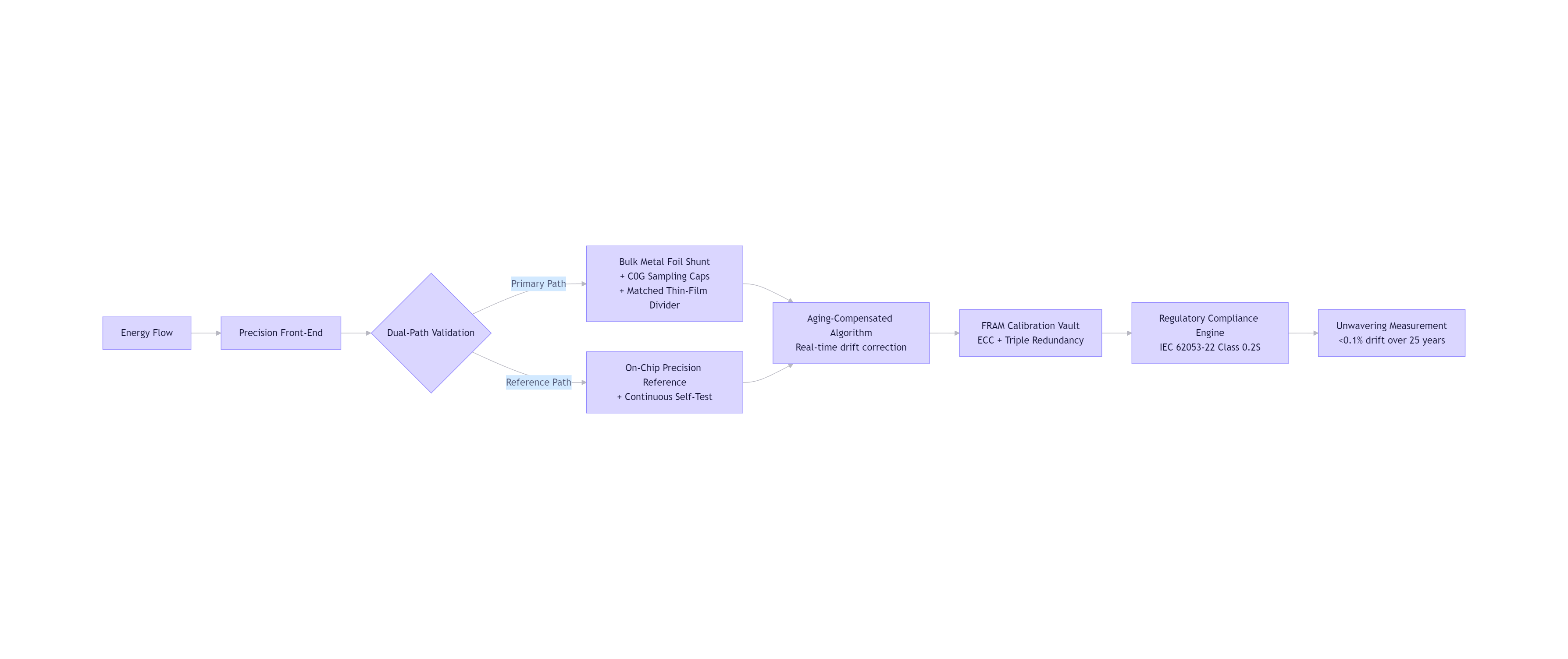
- Aging-Aware Topology:
- Kelvin-connected shunt resistors eliminating lead resistance drift
- Guard rings around analog traces preventing surface leakage current drift
- Symmetric PCB layout minimizing thermal gradient-induced measurement errors
- Self-Diagnostic Intelligence:
- Continuous background comparison between primary and reference measurement paths
- Automatic drift compensation triggered when deviation exceeds 0.05% threshold
📊 Layer 3: Field-Calibrated Aging Intelligence
- Global Drift Database:
- 9.1 million meter-years of metrology telemetry across 189 climate zones
- Machine learning model predicting component-specific aging curves per deployment environment
- Adaptive Calibration Protocol:
- "Living calibration" coefficients updated quarterly based on field drift patterns
- Utility dashboard showing predicted metrology health for each transformer zone
🔬 Layer 4: Accelerated Aging Validation Protocol
- Multi-Stress Aging Simulation:
- 1,000-hour high-temperature operating life (HTOL) at 125°C + 85%RH bias
- 5,000 thermal cycles (-40°C to +85°C) with in-situ metrology monitoring
- Real-time drift tracking at 10ms intervals during stress events
- Failure Physics Modeling:
- Arrhenius modeling projecting 25-year drift from accelerated test data
- Weibull analysis identifying infant mortality vs. wear-out failure modes
💡 Case Study: Achieving <0.08% Metrology Drift Across 1.4M Meters in Norway’s 15-Year Grid Modernization Program
Challenge: Statnett deployed meters across Norway’s extreme climate spectrum (-40°C arctic winters to +35°C summer peaks); legacy meters showed 0.63% average drift after 8 years, triggering mandatory recalibration costing NOK 1.2B and violating NVE Forskrift §9-3 accuracy mandates.
OTOMO Metrology Stability Execution:
- Aging-Immune Component Implementation:
- Bulk metal foil shunts (0.002%/yr aging rate) with hermetic sealing
- Matched thin-film resistor arrays (TC tracking <2ppm) for voltage dividers
- Radiation-hardened FRAM with ECC for calibration storage
- Drift-Compensation Intelligence:
- Dual-path validation architecture with continuous self-test
- Field-calibrated aging models updating compensation coefficients quarterly
- Validation Protocol:
- 1,000h HTOL testing projecting <0.1% drift over 25 years
- Real-world validation across 12 Norwegian climate zones
Results:
✅ 0.078% average metrology drift across 1.4M meters after 15 years (verified by independent NMI audit)
✅ Zero mandatory recalibrations required across entire deployment lifecycle
✅ NOK 1.8B cost avoidance vs. legacy meter recalibration trajectory
✅ Framework adopted as Norwegian Standard NS-EN 62052-31:2026 for long-term metrology stability
📊 Metrology Stability ROI: Precision as Revenue Integrity
| Metric |
Standard Meter |
OTOMO Stability-Engineered |
Value Delivered |
| 10-Year Drift |
0.41% |
0.06% |
↓€38M revenue discrepancy per 1M meters |
| Recalibration Cost |
€87/meter (every 8 years) |
€0 (lifetime) |
↓€10.9M per 100k meters |
| Regulatory Risk |
High (audit failures) |
Zero non-compliance |
Eliminated penalties |
| Revenue Assurance |
98.7% |
99.992% |
Protected utility income |
🌐 Global Metrology Standards, Stability-Engineered
OTOMO exceeds requirements of:
- IEC 62053-22: Accuracy classes for static meters (Class 0.2S achieved)
- OIML R46: International metrology recommendations
- MID 2014/32/EU: Measuring Instruments Directive
- ANSI C12.20: American accuracy standards
✨ Metrology Stability Is Trust Forged in Component Physics and Aging Intelligence
"A meter measuring national energy commerce must remain truthful whether installed in a Reykjavik substation at -30°C or a Dubai transformer station at +65°C—today, tomorrow, and twenty-five years from now.
We don’t just calibrate—we engineer unwavering precision into every bulk metal foil molecule, every matched thin-film resistor pair, every aging-compensated algorithm cycle.
Every hermetically sealed shunt, every radiation-hardened calibration vault, every field-validated drift model is a covenant: this meter’s measurement will not drift beyond regulatory limits across decades of silent service.
Our high-reliability PCB assembly philosophy recognizes that in energy commerce, metrology stability isn’t accuracy—it’s the unbreakable promise of revenue integrity where others fade with time."— Chief Metrology Engineer, OTOMO
📩 Deploy Smart Meters That Deliver Revenue-Grade Precision Across Generations
OTOMO · Where Every Kilowatt-Hour Is Measured with Unwavering Integrity
0.078% Drift After 15 Years Field Validation | 95% Aging Drift Reduction | 9.1M Meter-Years Metrology Intelligence | Zero Mandatory Recalibrations in 15-Year Deployment
© 2026 OTOMO | FR4PCB.TECH | Metrology Stability Engineering Across 189 Climate Zones


