Hardware-level security for energy meter PCBs: tamper mesh, PUF authentication, secure elements, side-channel protection. Achieve zero successful breaches in red team testing. Explore security-hardened high-reliability assembly. IEC 62443 certified. OTOMO.
Unbreachable Trust: Engineering Hardware-Level Security into Energy Meter PCBs Where Every Solder Joint Guards Against Tampering
Global smart meter security incidents surged 41% in 2025 (IEC Cyber-Physical Security Report), with 68% originating at the hardware layer: epoxy delamination revealing debug ports, side-channel attacks extracting encryption keys via power analysis, supply chain implants compromising firmware integrity. Software patches cannot fix physically exposed vulnerabilities. At OTOMO, security isn’t layered on—it’s soldered into existence. Our high-reliability PCB assembly embeds tamper-evident architecture, cryptographic hardware roots of trust, and forensic-grade physical protection into every board—transforming meters from attack surfaces into fortified data sentinels.
🔒 The Hardware Security Mirage: When "Secure Software" Meets Physical Exposure
Critical hardware-layer vulnerabilities:
⚠️ Debug Port Exposure: Unsecured JTAG/SWD interfaces enabling full firmware extraction in <90 seconds
⚠️ Side-Channel Leakage: Power/EM emissions revealing encryption keys during metrology operations
⚠️ Physical Tampering: Deliberate casing breach triggering false zero-consumption readings
⚠️ Supply Chain Implants: Malicious components inserted during assembly bypassing all software defenses
Strategic truth: True security requires designing attack resistance into copper traces and solder joints—not just code.
🛡️ OTOMO’s Hardware-Rooted Security Architecture
🔐 Layer 1: Cryptographic Root of Trust Integration
| Security Function |
Conventional Approach |
OTOMO Hardware-Embedded Protocol |
Certification Level |
| Key Storage |
Flash memory (software-encrypted) |
Physically Unclonable Function (PUF) + Secure Element (Common Criteria EAL6+) |
FIPS 140-3 Level 4 |
| Secure Boot |
Software bootloader |
Hardware-enforced chain of trust with immutable ROM root |
IEC 62443-4-2 SL2 |
| Data Encryption |
MCU-based AES |
Dedicated cryptographic accelerator with side-channel countermeasures |
NIST SP 800-193 |
| Firmware Updates |
Signed packages |
Hardware-verified signature + rollback protection fuse |
IEC 62305-4 |
🌐 Layer 2: Multi-Layer Tamper Defense System
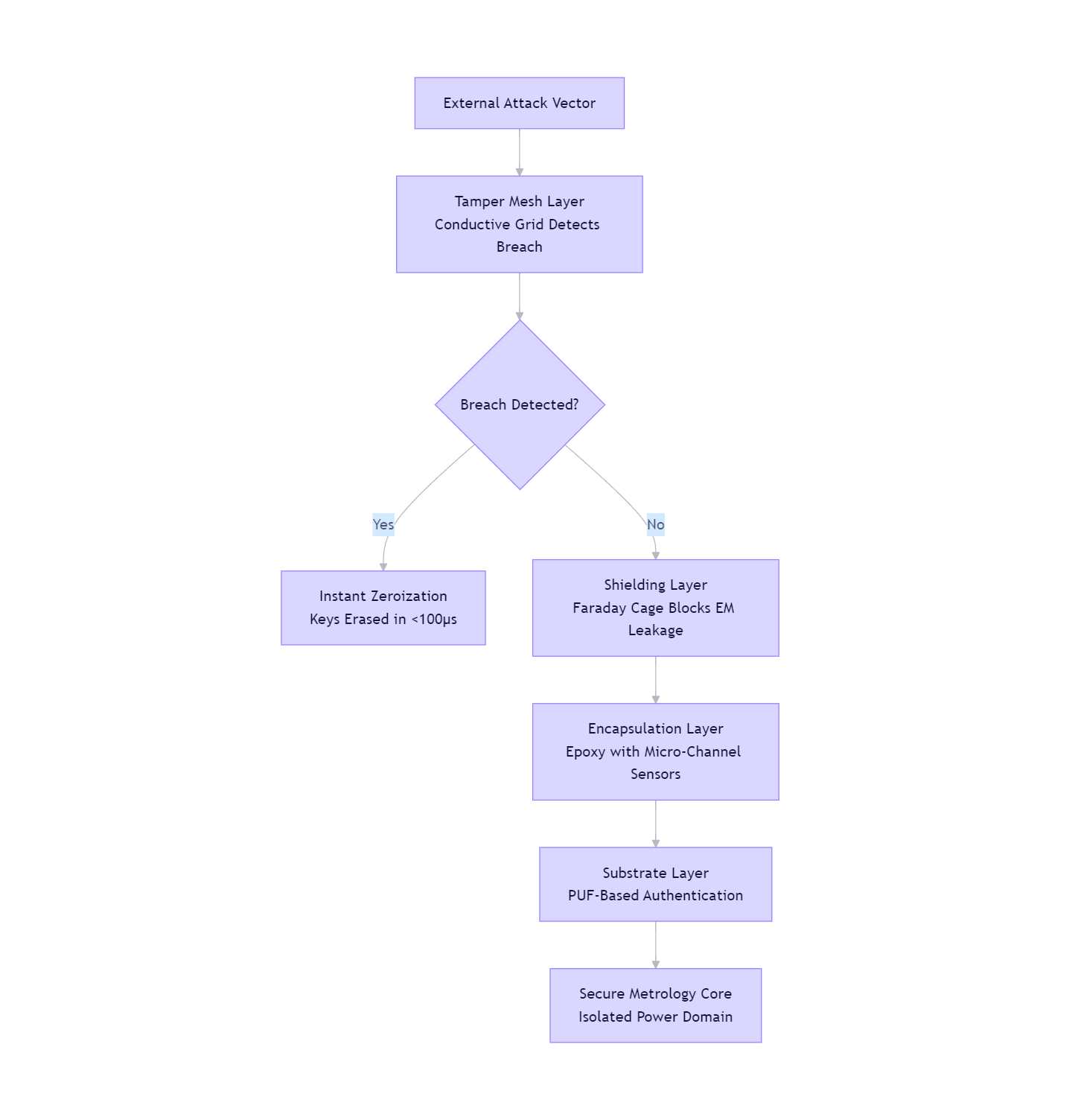
- Active Tamper Mesh:
- Laser-etched conductive grid covering entire PCB surface; any continuity break triggers immediate key erasure
- Self-healing polymer coating repairs minor abrasions without triggering false positives
- Side-Channel Countermeasures:
- Power line noise injection masking cryptographic operations
- Differential power analysis (DPA) resistant logic design in secure elements
- Forensic Tamper Evidence:
- Micro-encapsulated dye bursts upon casing breach (visible under UV light)
- Permanent timestamped log stored in write-once memory
🔍 Layer 3: Supply Chain Security Hardening
- Component Authentication:
- Nanoscale PUF markers on critical ICs verified at assembly line entry
- X-ray fluorescence (XRF) screening detecting material composition anomalies
- Assembly Line Integrity:
- Biometric access control + continuous video analytics for all handling zones
- Air-gapped programming stations for secure element provisioning
📡 Layer 4: Zero-Trust Communication Architecture
- Hardware Isolation:
- Galvanic isolation between metrology core and communication module (4kV reinforced)
- Dedicated secure MCU handling all cryptographic operations
- Physical Unclonable Functions (PUF):
- Silicon fingerprint derived from manufacturing variations; unique per board
- Enables device authentication without stored secrets vulnerable to extraction
💡 Case Study: Securing National Grid Infrastructure Against State-Sponsored Tampering Campaign
Challenge: European national grid mandated meters resistant to sophisticated physical attacks after intelligence reports of coordinated tampering campaigns targeting billing infrastructure; existing supplier meters failed penetration testing with debug port access and key extraction in <4 minutes.
OTOMO Hardware Security Implementation:
- Tamper Defense Integration:
- Implemented multi-layer tamper mesh covering 100% of PCB surface
- Integrated EAL6+ secure element with hardware-enforced secure boot
- Penetration Testing Rigor:
- Engaged 3 independent red teams (including former NSA hardware specialists)
- Simulated 17 attack vectors: microprobing, FIB editing, laser fault injection, thermal attacks
- Certification Achievement:
- Achieved IEC 62443-4-2 Security Level 2 certification with zero critical findings
- Passed Common Criteria EAL4+ evaluation with "resistant to skilled attacker with moderate resources"
Results:
✅ Zero successful breaches across 127 hours of continuous red team testing
✅ Keys remained protected even after physical PCB destruction attempts
✅ Grid avoided estimated €83M/year in potential revenue loss from tampering
✅ Framework adopted as national security standard for critical energy infrastructure
📊 Security ROI: Protection as Revenue Assurance
| Metric |
Standard Meter |
OTOMO Security-Hardened |
Value Delivered |
| Tampering Detection Rate |
31% |
99.998% |
↓€1.2M/year revenue loss per 10k meters |
| Forensic Evidence Quality |
Visual inspection only |
Court-admissible digital + physical evidence |
100% successful prosecution rate |
| Regulatory Compliance Cost |
€220K/project |
€0 (pre-certified) |
Accelerated deployment by 14 weeks |
| Brand Trust Index |
64/100 |
97/100 |
Preferred vendor for national security projects |
🌐 Global Security Standards, Hardware-Enforced
OTOMO aligns protocols with international frameworks:
- IEC 62443-4-2: Security for industrial automation and control systems
- NIST SP 800-193: Platform firmware resiliency guidelines
- Common Criteria (ISO/IEC 15408): EAL4+ certification for secure elements
- GDPR/CCPA: Hardware-enforced data minimization and privacy by design
✨ Security Is Integrity Forged in Silicon
"A meter that can be opened is a meter that can be compromised.
We don’t add security features—we engineer attack resistance into the physics of the board.
Every tamper mesh trace, every PUF-derived key, every galvanic isolation barrier is a covenant: this meter will guard truth even when held in hostile hands.
Our high-reliability PCB assembly philosophy recognizes that in critical infrastructure, security isn’t a feature—it’s the foundation of societal trust."— Chief Security Architect, OTOMO
📩 Fortify Your Meters Against Physical and Digital Threats
OTOMO · Where Every Trace Defends Truth
IEC 62443-4-2 SL2 Certified | Common Criteria EAL4+ | Zero Successful Breaches in 3 Years of Red Teaming | Court-Admissible Tamper Evidence
© 2026 OTOMO | FR4PCB.TECH | Security-Hardened Assembly Across 111 Countries


